Take a look at this image:
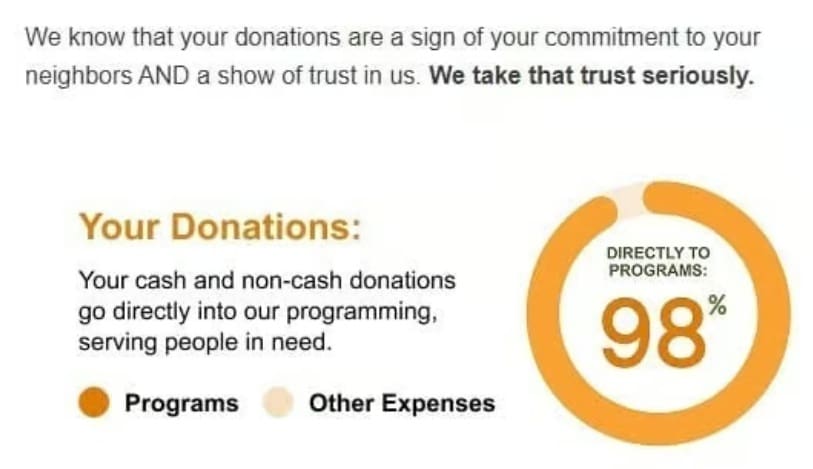
I asked my enewsletter subscribers to evaluate the image. A bunch of them were very skeptical of that 98% program number. Are they playing games with how they define and calculate overhead?
Some wondered what “other” actually means. Others assumed that they don’t pay a decent salary to their staff. I got reactions stating that the organization is not building a sustainable model to continue doing their good work in the future.
The overwhelming sentiment? Upset and mad. Are they implying that any organization that spends more than 2% on “other expenses” is wasting money and can’t be trusted? With so many indirect expenses that an organization deals with, how could it possibly only cost 2% to administer their programs???!!!
I agree with it all. But when a bunch of you stepped back from your nonprofit roles and really looked at it thru the reader’s eyes, you agreed that it looks great. Almost all of a donor’s gift is going to much needed programs and services. And donors will love that.
My message today is NOT to play with numbers, lie, make overhead as small as possible etc. Instead, as year-end campaigns go into full swing, I want to remind you of one of the basic principles and best practices of fundraising and marketing:
It’s not about “we” the organization. It’s about “you” the donor. And it’s about writing from the reader’s perspective.
As you get set to email, call people, meet donors, post on social and more, let’s dive into “we” vs. “you” and why it’s critical to surpassing your year-end goals.
How to discuss impact
For almost my entire career in house, I wore a hundred hats at once. Today I work with clients who are short staffed and have a million and six tasks to take care of. I know how hard ALL of you work to make the world a better place.
And in case no one has said it to you recently, lemme say it: THANK YOU FOR ALL YOU DO!
As you begin the year-end craziness, you need to remember one crucial point. When you share an impact letter with a donor and it reads “in the last year we helped 3,500 children; we sponsored 1,200 scholarships; we provided backpacks to 5,785 students” you end up forgetting someone mighty important:
The donor.
Yes, I know you did all the work. Spent time inputting data, buying products, dealing with outside suppliers, finding volunteers and on and on. That’s the “we.”
But when you tell donors about impact, it has to be about “you,” the donor.
I do not know how to end homelessness in my neighborhood. But because your organization has an expertise in this area, I donate to your nonprofit in the hope of helping to solve the problem. Yes, it’s a partnership (can’t have one without the other) but when talking to donors, make it more about them than your organization.
This is why I say more “you”, less “we.”
That does not mean not mentioning your part in this. You absolutely need to be there! But when it comes to your fundraising communications, review it: The ratio should be 3:1 for you:we.
If you see more “we” than “you,” rewrite.
This year-end, I hope you’ll be leading with gratitude and impact. For both of those types of communication, making the donor feel like they’re doing something amazing is critical to what comes next.
You’re gonna make an ask.
Want them to respond and give? Make them feel all the love at being able to make a positive change in their community.
Look at the communications you’ll be sending between now and December 31. Count the you and we. Make changes where needed.
Supporters need to feel- and know!!!- that their hard earned dollars are going somewhere which matches their values and makes the world a better place. Help them feel that by sharing comms that high fives them.
Watch your retention go up. Watch the amount you raise go up. Watch how you can help more people than before.
That’s the power of “you.”