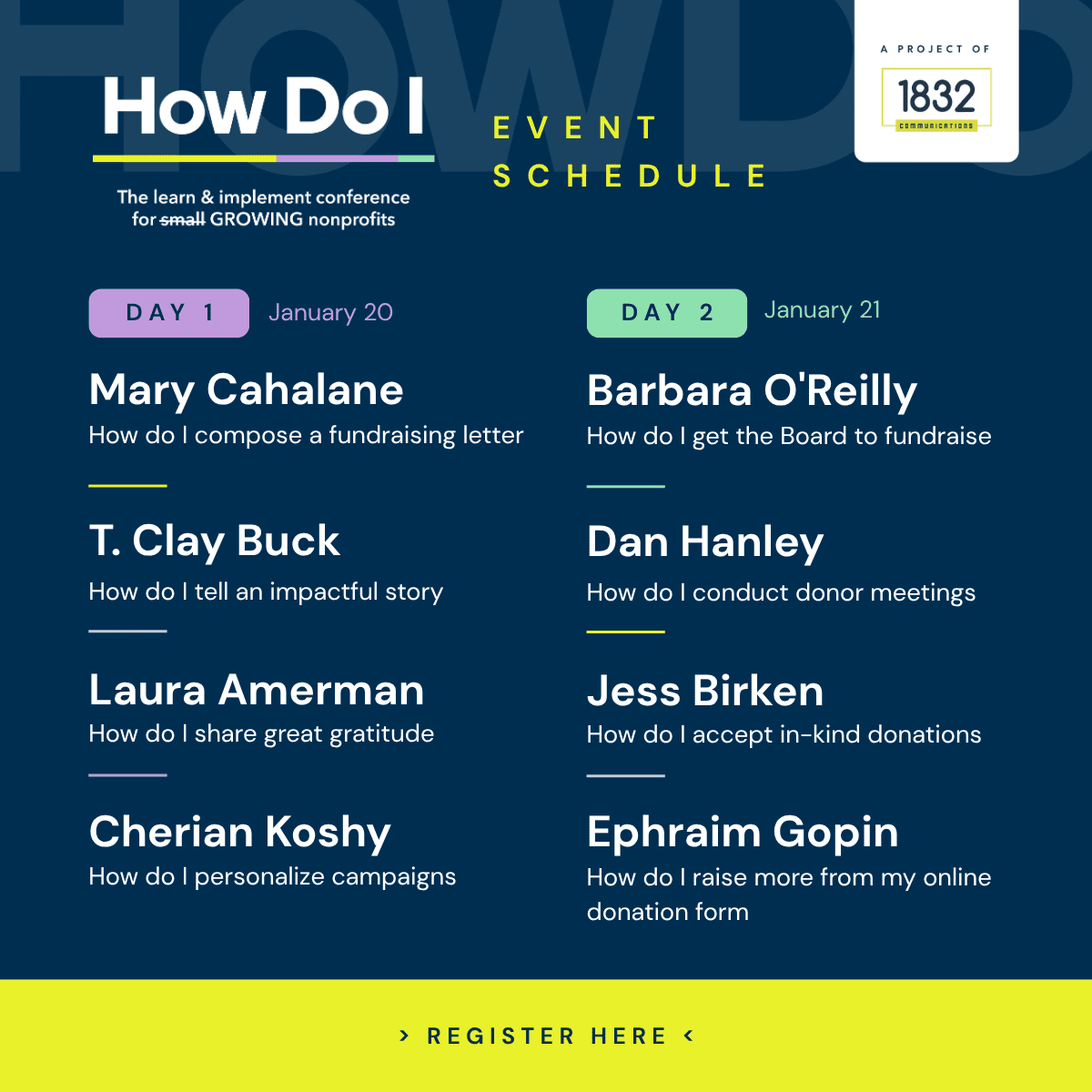
Spots are filling up for the How Do I online conference. Buy your ticket/s today and attend the only fundraising conference dedicated to helping staff at growing nonprofits (budget below $5 million)- especially one and two-person shops!- fundraise successfully in 2026 and beyond!
My fifth annual Giving Tuesday 2025 Emailpalooza Review Extravaganza is here!
I opened, read, reviewed and analyzed all 576 Giving Tuesday (GT) emails I received from 104 different nonprofits of all sizes. This year’s review is divided into four parts. Read part two, part three and part four.
As in previous years, I’ll be sharing insights, tips, strategies, how to and best practices to help with your fundraising, marketing, email, storytelling, content and much more. Let’s dive in!
The data
1. Just because Giving Tuesday was Tuesday December 2 doesn’t mean you shouldn’t have had the chance to donate in advance, right?
38.3% of emails that arrived before GT mentioned “early access.” Which drives me nuts.
Wanna remind people of the date? Fine. But to ask them to give in advance because your organization needs the money NOW?! Not cool.
And access to what? None of the early access emails made it clear that by giving before GT subscribers would get access to something special. Early access is simply copying language from Black Friday and Cyber Monday. And it sucks.
2. The email addresses organizations used were for the most part yucky. The “from” and “reply to” email addresses are extremely important! Email is one-to-one communications with an individual subscriber and the from and reply email should reflect that.
You should want the name of a person for the “from” and “reply to.” Give people the feeling that you WANT to hear from them (which you do because that means having a private conversation with them and finding out about THEIR needs). If someone responds, now you’re having a one-to-one conversation with a specific subscriber.
I judged email addresses in three categories: Good good (both “from” and “reply to” are the name of a staff person), good bad (either “from” or “reply to” is the name of a person), bad bad (neither the “from” and “reply to” address are the name of a person). GT breakdown:
- Good good: 7.3%
- Good bad: 5.4%
- Bad bad: 87.3%
As you can see, the vast majority did not use the name of a person for both the “from” and “reply to” address. Don’t be like them.
16.5% of ALL GT emails used “info@” for the from and “info@” for the reply address. Who’s gonna reply to something so generic?! It makes people wonder if someone is monitoring that email address if someone decided to write to it.
Using info@, office@, contact@, comms@ and generic email addresses like those prevent people from paying attention to your emails and responding. Use a name.
Gratitude Tuesday
A shoutout to all the organizations who did Gratitude Tuesday- spent GT contacting donors and genuinely thanking them for their support… with no strings attached. No ask whatsoever. I’m a big fan!
Every year Second Helpings in Indianapolis does Gratitude Tuesday. Their Board Chair, fundraising expert Adam Clevenger, tells me that in just one day they made 2,445 calls to supporters!!!!!! At one point in the day, they had 15 volunteers making calls:

Photo courtesy of Adam Clevenger
Always lead with gratitude. With year-end campaigns in full swing, using Giving Tuesday to say thanks before year-end emails flood everyone’s inbox is perfect. People appreciate a heartfelt thanks for their generosity and during the calls they hear about the impact of their gift- which also makes them feel good. So when the organization does make an ask, there’s more of a chance the donor will give again.
Way to go Second Helpings!
Doctors Without A Clue
Out of the 104 nonprofits who sent me GT emails, Doctors Without Borders (DWB) sent the most emails. And their emails weren’t that great.
They sent 26 emails in a 17-day span. They sent 3 emails the day before GT. They sent 7 on GT itself.
Nooooooooowwwwww… I’m a huge proponent of nonprofits sending MORE emails. I don’t think they email enough. But sending 10 emails in less than a two-day span is a bit overdoing it.
Exhibit A: Their first GT email arrived on November 17, 17 days before GT. But it was their next email that set me off.
That email arrived only eight hours later. It included at the top a note from their Chief Development Officer. Here’s what it looked like:

In a regular fundraising campaign, this is a good tactic to try once. Send an “intro” email to ask people if they saw the below email. (Below the above note from Deborah was the email they had originally sent eight hours earlier.) Not everybody opens every email you send so doing this can serve as a reminder encouraging people to read and interact with your email.
But when the actual giving day is FIFTEEN DAYS AWAY, you don’t do this! Unless you’re viewing GT as a big cash grab and you want your money NOW, no matter how far off GT is. Yuck.
Exhibit B: I am all for emails addressing cart abandonment (you started the checkout process but abandoned it in the middle) in ecommerce. Same goes for email related to finishing to give a donation online.
I received an email from Doctors Without Borders with the subject line: “We noticed you didn’t quite finish your donation.” Of course not. I never clicked the CTA button to give a gift.
But then the second paragraph opens with: “We noticed that you weren’t able to complete your donation and take advantage of our early Giving Tuesday 3X MATCH.” But I never clicked the button to go to the online donation form!
There are three possible scenarios here.
- I clicked but don’t remember doing so. But even if I clicked by accident, I did not start filling out any forms. That I’m sure of.
- This email was sent to me by mistake. Possible.
- This was an INTENTIONAL email sent to make me think I had started the process of giving a donation, making me think maybe I did wanna give to them and thus providing the organization with a few more donations from people who were too busy to remember what they did or did not do a few hours ago.
If number three was their strategy, then Doctors Without Borders stinks because that’s a horrible thing to do to people.
Exhibit C: This is the worst offender. I HATE HATE HATE HATE HATE their email footer image:
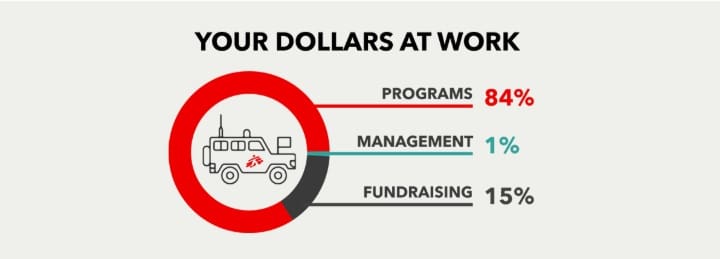
Pardon my French but this is bullshit.
This appears at the bottom of EVERY email they send. Why? Because they want to show everyone how low they keep overhead. They want people to think that at least 84 cents of every dollar donated goes directly to programs and services.
The other 16%? Admin costs. (As if programs and services have no admin costs 🙄)
Know what it says to me? They keep staff salaries low. They don’t pay fair wages. They don’t invest in their people and/or fundraising. They’re not building a sustainable model to continue doing good in the future.
And is the implication that other nonprofits with higher “overhead” aren’t to be trusted because they don’t invest as much as DWB in their programs?
DWB has had this image in their email footer for the last five plus years. They need to do away with it. It’s possible it helps with raising money (donors like knowing that only a small proportion of a donation goes to “overhead”). But it hurts the entire sector when a budget is presented in this fashion.
Enough is enough.
No one cares
A decent number of organizations shared their internal fundraising goal (they wanted to raise X amount of dollars). But here’s the thing- and I’m putting this in all caps for those at the back:
NO ONE CARES ABOUT YOUR INTERNAL FUNDRAISING GOAL!!!
So Americares, this is NOT how you should open an email to me: “Our 5X Giving Tuesday match is live and we need to share an urgent update with supporters like you: We’re falling short of our critical $500,000 goal.”
I don’t care about YOUR internal dollar goal and it’s not my fault you haven’t hit it yet. Which is why you also shouldn’t email me with the subject line “FINAL EXTENSION: Please check your donation record.”
Fundraising is not transactional!
Should you mention your dollar goal in a campaign? Yes. All good. But it should not be the center of your email and the reason why people need to give to you.
Focus on who will be helped and what the impact will be. You’ll raise a lot more.
Wanna learn how to write fundraising emails that convert? Purchase my 101 Email Fundraising Tips ebook and you’ll have everything you need to craft emails which hit the mark. (Not sure what content to send subscribers besides a fundraising ask? I got you covered! Purchase my 101 Email Content Ideas that are NOT a Fundraising Ask)
Let people know
If possible, every fundraising email should have a P.S. which contains a one sentence summary of the campaign/ask. People read the P.S.!
The American Diabetes Association had a very interesting P.S. prior to Giving Tuesday.

Always a good idea to provide updated helpful information.
Capture attention immediately
The average email read rate is under 9 seconds. You have a millisecond to capture a reader’s attention. This is why a hero image (image at the top of the email) is super important. Like this one from Easterseals:
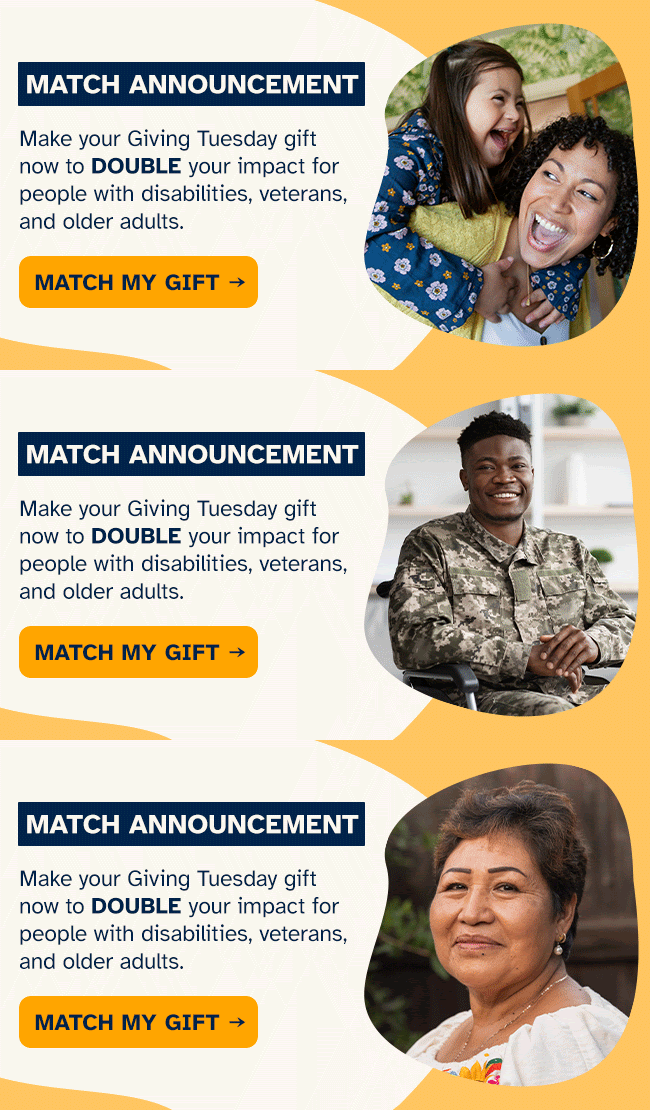
Definitely captures my attention and gives me an idea who will benefit from my gift.
Do they know me?
On Giving Tuesday, the Michael J. Fox Foundation for Parkinson’s Research had a matching campaign for first-time donors. First time giving to MJFF? Your donation will be doubled.
Why do I love this? They segmented their list! They know I’ve never made a financial donation. They segmented me out of their list to receive this specific email. Good stuff!
Pro tip: Have a matching campaign? Make sure your audience knows about it. You’ll get more people giving at higher amounts.
What do you think?
Before Giving Tuesday, a bunch of nonprofits sent me “save the date” emails. The goal was to remind me of the upcoming cash grab… I mean giving day and encourage me to put it on my calendar so I don’t forget.
Does that work? Do people actually add it to their calendars? I’m seriously asking because I’m not sure and I’d love to hear from you about this!
Part 2 of my review– “You keep using that word. I do not think it means what you think it means.”
Are you a staff member at a growing nonprofit (budget below $5 million)? Want to learn how to fundraise successfully in 2026 and beyond?
Then attend the How Do I online conference on January 20 and 21! 8 fundraising experts will teach you step by step the strategies, best practices, practical advice and how to fundraise. Attend, learn and implement what you learn right away at work!
Spots are filling up. Buy your ticket/s today (discounts available for more than 1 ticket)!
Here’s a list of the sessions: