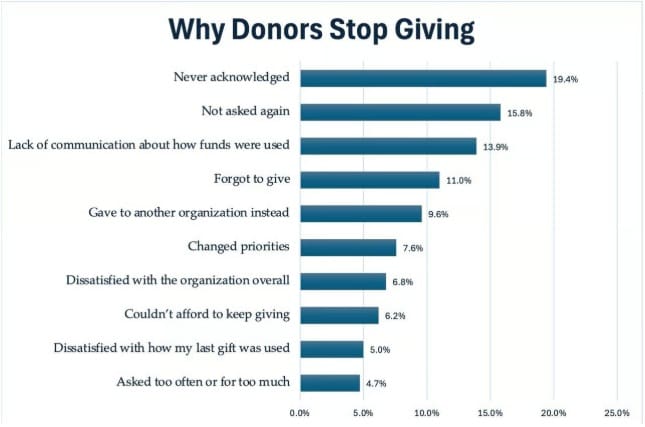
IMPACTS Research by Societ analyzed the giving of 98,000 donors who donated between $250-$2,500 but hadn’t given to that organization in two years.
The question: Why did you stop giving?
The data:

I’m gonna share tips and advice for how to deal with each issue.
1️⃣ Never acknowledged: No friggin way. This kills me.
I am willing to bet that a portion of this is people who never opened a thank you email/letter or they misplaced it or something else. But that’s the number one reason?! We got work to do!
Your ability to raise funds is highly dependent on saying thank you to donors. And not just the transactional, bizlike thanks. I’m talking heartfelt, warm, sincere and genuine.
✅ The fix: Take a minute today and review your processes. Make sure email thank yous are automatically being sent after an online donation. Look to see that thank you letters sent by mail are going out promptly (best if sent within 48 hours of a gift).
If you’ve been here long enough, you know I’m a huge fan of phone calls to thank people and inform them of the impact of their gift. Phone calls can also be a great follow up to sending a thanks letter/email.
But every gift- no matter the size- should be acknowledged. Full stop.
2️⃣ Not asked again: I saw this a screamed.
How the heck is this number two?! This may help explain the abysmal retention rate in the sector (40%) and the horrible first-time donor retention rate (18%). If you’re not asking, they won’t give again!
✅ Easy fix here: Ask again and again and again and again!
3️⃣ Lack of communications about how funds were used: I declared 2026 to be the year of consistent and constant communications. And here’s my proof why that’s so important.
Think of all the tools in your comms arsenal: Website, email, social media, video, phone calls, blog, text, direct mail, in person meetings. You have plenty of ways to keep in touch with people and let them know the impact of their gift.
And yet…
You WANT people to hear from you. You WANT to keep them in the loop. You WANT to make them feel good about giving.
Are you telling stories? Sharing testimonials? Posting videos about the impact of gifts? Sharing data about the problem and how donors are helping to solve it? Finding educational content that will add value to the donor’s experience?
This is why having a combined fundraising and marketing strategy is critical. They both work together to help with the donor cycle of gift, gratitude, stewardship and the next ask.
✅ A fix for you to initiate: Do an audit of your overall communications with supporters. Are they hearing from you enough? What content are you sharing with them? Are they reacting to it?
Survey/speak to supporters and ask them what types of comms they’d appreciate- what they want to hear from your organization. The more ya know… (If you need help with this audit, reply to this email. Audits are one of the services I offer.)
👀 Further reading: What your donors wish you knew
4️⃣ Forgot to give: Yes, this can happen. People forget to do things all the time. But I think your organization can help prevent this some of the time.
✅ You already know the fix: Consistent, constant comms! The more often they hear from you and the content you provide is valuable, the greater the chances they’ll see and remember you.
Quick story: This past December I helped manage the end of year email campaign for a nonprofit. They sent out more emails than usual in December. A donor got in touch and said:
“I was looking at my inbox and I saw your name. It reminded me that I hadn’t given my annual $5,000 donation. Thanks for the reminder!”
The donor didn’t even have to open up the email. Inbox visibility was enough to serve as a reminder.
Make sure people hear from you often enough with great content they want to engage with. They won’t forget you.
Let’s break it down some more
5️⃣ Gave to another organization/Changed priorities: You’re not going to keep 100% of your donors. People over time move on to other causes.
It’s important to remember what fundraising expert Mark Phillips says:

As we’ll see in a second, if people don’t think you’re providing them what they need as a donor, they have plenty of other choices. And they won’t hesitate to move.
✅ A fix to implement: Better comms with your donors! Talk to them, get to know them better, build the relationship. If you have a connection with them, you’ll know when their priorities have changed and you won’t be surprised when they give elsewhere.
And just a small tip: If you do hear from a donor that they will not be continuing to give to your organization, don’t get angry. Thank them profusely for their past support, appreciate that they will continue to give (even if elsewhere) to make the world a better place and wish them well. Because ya never know when they might consider coming back to you.
6️⃣ Dissatisfied with the organization overall/Dissatisfied with how my last gift was used: Trust in nonprofits is low. So these two don’t surprise me.
Part of this is a lack of comms, lack of reporting, lack of relationship building. If donors believe they have a true connection with you, they’ll tell you why they’re not happy with your organization.
And that info is critical for you to have! You need to know what people are saying about you- the good and the not so good.
✅ The fix: Improve your reporting to supporters. Measure satisfaction (through polls and surveys). Connect with people so when necessary you have the tough discussions.
👀 Further reading: How to secure the trust of your donors
7️⃣ Couldn’t afford to keep giving: I’m sure many of you are hearing this from your donors right now. With costs rising, people being laid off and more, it’s not great out there.
But when a donor says they cannot give this year, you want to avoid what I’ve seen some fundraisers do: Stop engaging with these supporters.
NO! Just the opposite.
✅ The fix: Someone tells you they can’t give this year? Your response:
- Show understanding, sympathy and empathy. It’s not a good feeling to have to tell a charity you love that you just don’t have money to donate this year.
- Offer assistance. Ask if there’s anything you/your organization can do to help them. Fundraising and marketing is a two-way street!
- Do NOT remove them from your donor’s list. Continue to send them regular comms as if they gave.
- Continue engaging with them as if they gave. Find ways to strengthen the relationship.
When the time comes and they can give again, they will remember that you stood by them when they needed it most.
8️⃣ Asked too often or for too much: If you’ve been here long enough, you know I think that nonprofits don’t ask often enough. So even though this is on the list, it’s at the bottom. And I still say keep sending.
As for asking too much…
✅ The fix: Get to know your donors! This can include wealth screenings as well as learning more about them. Know their past giving amounts, what they like giving to and the values that are most important to them.
P.S. Two things run through all of the above:
- The importance of building relationships with your donors
- Constant and consistent communications with donors
Do the above two really well and you’ll successfully surpass your goals!