Spots are filling up for the How Do I online conference. Buy your ticket/s today and attend the only fundraising conference dedicated to helping staff at growing nonprofits (budget below $5 million)- especially one and two-person shops!- fundraise successfully in 2026 and beyond!
My fifth annual Giving Tuesday 2025 Emailpalooza Review Extravaganza is here- part two!
I opened, read, reviewed and analyzed all 576 Giving Tuesday (GT) emails I received from 104 different nonprofits of all sizes. This year’s review is divided into four parts. Read part one, part three and part four.
As in previous years, I’ll be sharing insights, tips, strategies, how to and best practices to help with your fundraising, marketing, email, storytelling, content and much more. Let’s dive in!
The data
1. Only 4.9% of GT email subject lines contained my first name. Why is this significant? Because addressing me by name in the subject line can dramatically increase the open rate.
Email inboxes are overflowing. As people scroll through, they’ll stop when they see their name. That’s an opportunity for an open. Way too few GT email subject lines included my first name.
2. 23.4% of GT emails mentioned a matching gift.
This is important! When a fundraising campaign includes a match (example: Every dollar donated will be matched by a donor), more people give in higher amounts. After all, my donor dollar goes twice as far!
Many organizations ask top donors to make a large gift around a campaign and ask permission to use the gift as part of a 2x, 3x etc. match. Donors like this because it means their donor dollars will have double the impact.
Who writes the email matters
During their GT campaign, Special Olympics sent me two emails which piqued my interest. One was written by a former Special Olympics athlete who now serves on their International Board of Directors. The other was composed by Maureen McCormick. You might remember her as Marcia Brady on The Brady Bunch. Her brother used to be a Special Olympics athlete.
When putting together your fundraising email asks, consider who the emails will come from. It doesn’t always have to be from the CEO or Board Chair. Don’t forget staff, beneficiaries, volunteers and others who would be happy to share why they give to your organization.
Wanna learn how to write fundraising emails that convert? Purchase my 101 Email Fundraising Tips ebook and you’ll have everything you need to craft emails which hit the mark. (Not sure what content to send subscribers besides a fundraising ask? I got you covered! Purchase my 101 Email Content Ideas that are NOT a Fundraising Ask)
Do you even know what it means?
I’m about to rant so I apologize in advance.
“GivingTuesday was created in 2012 as a simple idea: a day that encourages people to do good.” – Giving Tuesday website
If you had reviewed 99% of the GT emails I got, you’d come to the conclusion that the only way to encourage people to do good is to get them to give money. It’s become a cash grab. And that’s one of the main reasons why I dislike GT.
But don’t take my word for it. Here’s how some of the nonprofits described GT in their emails this year:
“Tomorrow is Giving Tuesday, the International Day of Giving when we show what matters most to us.” (Next sentence mentions their internal dollar campaign goal)
“Today is the day we put our values into action, supporting organizations that touch our lives and make a difference in our communities.” (Next paragraph mentions how to put values into action- help them raise $25,000.)
“Today is Giving Tuesday, the biggest day of charitable giving each year.”
“On this special day when we support the causes that are most important to us…” (sentence continues with an ask for a financial donation)
And that’s just a sampling. In fact, only ONE organization highlighted other ways to do good on GT besides a financial donation. But everyone else treated the day like a big cash grab: Ask, ask, ask. Because that’s the only way to do good. All the eyerolls.
Kudos to the British Heart Foundation!
There are plenty of other ways to do good on GT than just a financial donation. Thankfully, one organization in my inbox remembered this:
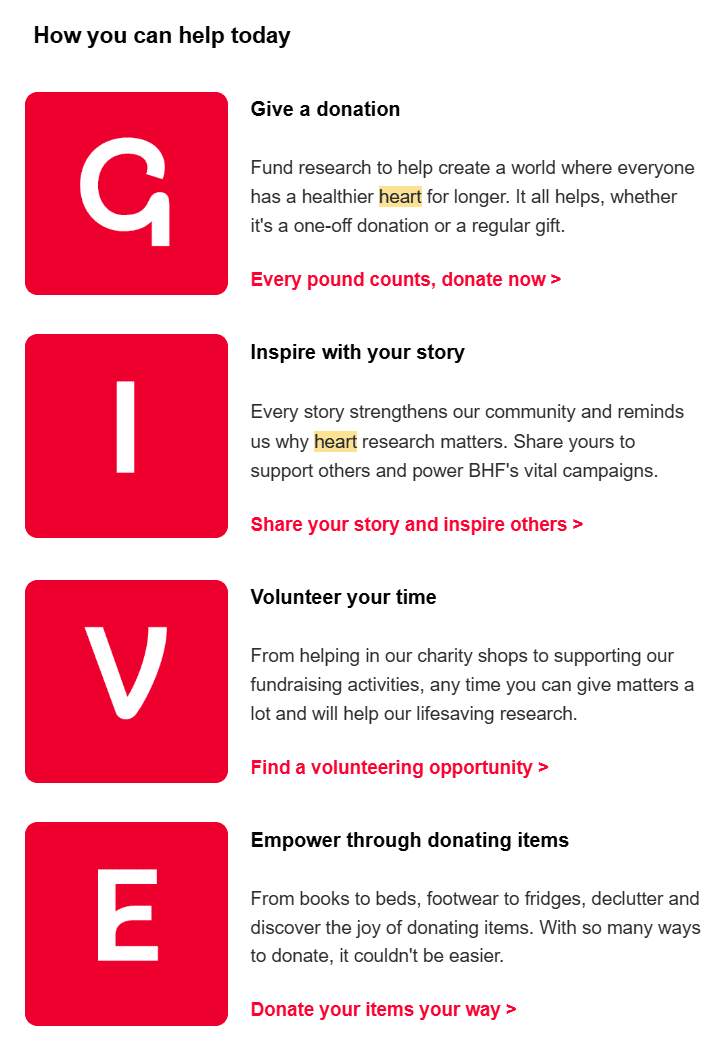
Kudos to the British Heart Foundation for sharing this!
Don’t confuse people
Two weeks before GT, the International Relief Committee (IRC) opened an email with this: “Because you’re an IRC insider, you don’t have to wait until Giving Tuesday to make an even greater impact.”
I had no idea I was an insider! What does that even mean??? I’ve never donated to them and I’m not a member of any sort. So how do they determine that I’m an “insider”? (And again, what does that mean?)
I know you want people to feel close to the cause. But using a term which means nothing to the reader can have the opposite effect.
Spread the word
I’m a big fan of the email efforts of Alex’s Lemonade Stand Foundation. One of their GT emails included this:
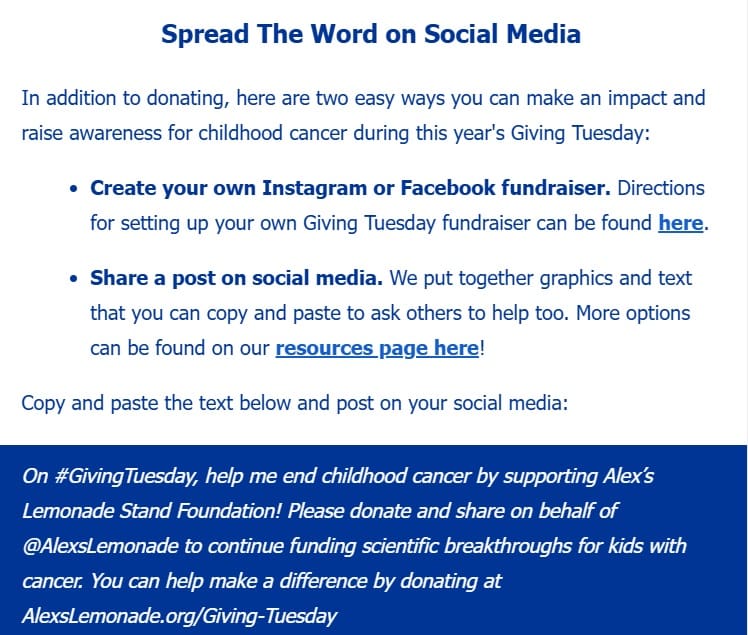
They make it easy for their audience to share about their GT campaign on social media. They provide resources, prepared text and more. THIS is how you do it!
Make it easy for your audience to share your campaign with their network. Get more eyeballs on your mission, impact, programs and hopefully attract new people to support your cause.
But why?
Ocean Conservancy had a GT dollar-for-dollar match. One of the ways to get more people giving more is to show them how their dollar goes farther. Here’s the image Ocean Conservancy shared:
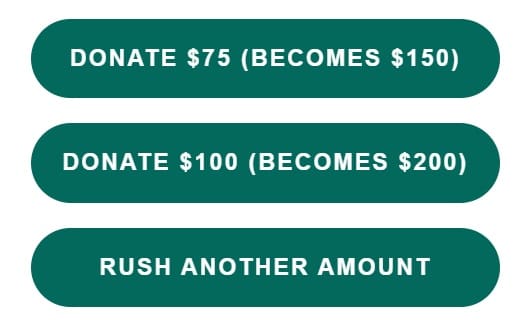
The idea is a good one. But I don’t understand why the doubled amount is in parenthesis, as if they want to hide it. That’s the part that should stand out!!! Don’t make it like it’s secondary to the actual giving amount. Highlight the matched number so people feel doubly better about giving.
But if it’s about the money…
Offer donors more than just a credit card donation. Action Against Hunger offered this:
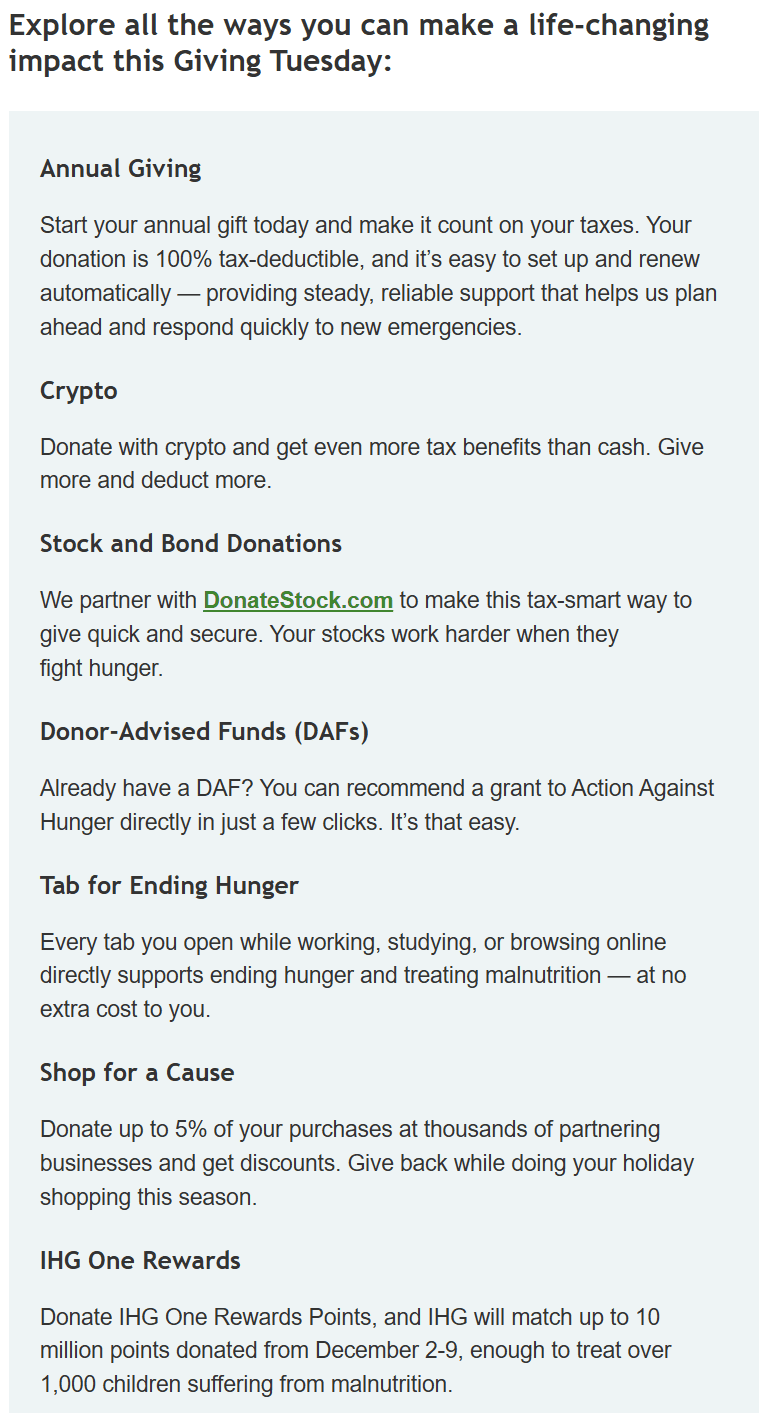
A diversified fundraising portfolio is critical for success. Offer multiple giving options so you can attract as many donors as possible.
I love this!
Open Table (Concord, MA)- whose mission is to end hunger in our local community by providing healthy food in ways that respect the dignity and diversity of those served- had a very different P.S. in one of their GT emails:
“Another simple way to help: Donate your empty egg cartons. We receive eggs in bulk cartons and rely on donated cartons to distribute dozens and half-dozens to our clients.”
I guess it wasn’t just the British Heart Foundation offering other ways to give besides money!
What do you think?
In part one I mentioned how no one cares about your organization’s internal fundraising goal. Just because you’ve decided that you have to raise $50,000 doesn’t mean I have to give.
This year a number of organizations didn’t use a monetary goal. They used a people goal- number of donations. They wrote in their emails that their goal is to get X number of donors giving.
Question for readers: Does this motivate people to give? Email me your thoughts!
Part 3 of my review– It’s all about the storytelling
Are you a staff member of a growing nonprofit (budget below $5 million)? (I’m lookin at you one and two-person shops!) Not sure how to raise enough to meet the local need? Tired of the constant stress of trying to meet your fundraising goals? Not sure of the best ways to raise money, build relationships and boost retention? Want to SURPASS your fundraising goals so your organization grows and thrives?
Then join us at the How Do I conference! On January 20 and 21, over 8 sessions, 8 fundraising experts are going to teach you how to compose a fundraising letter, share great gratitude, craft a compelling story, get the Board to fundraise, conduct in person donor meetings and much more!
You’ll learn the steps and get the know how to implement what you learn right away. Attend, participate and fundraise successfully in 2026 and beyond.


